
How Many Beds Should Your Vacation Rental Have? A Guest Capacity Guide
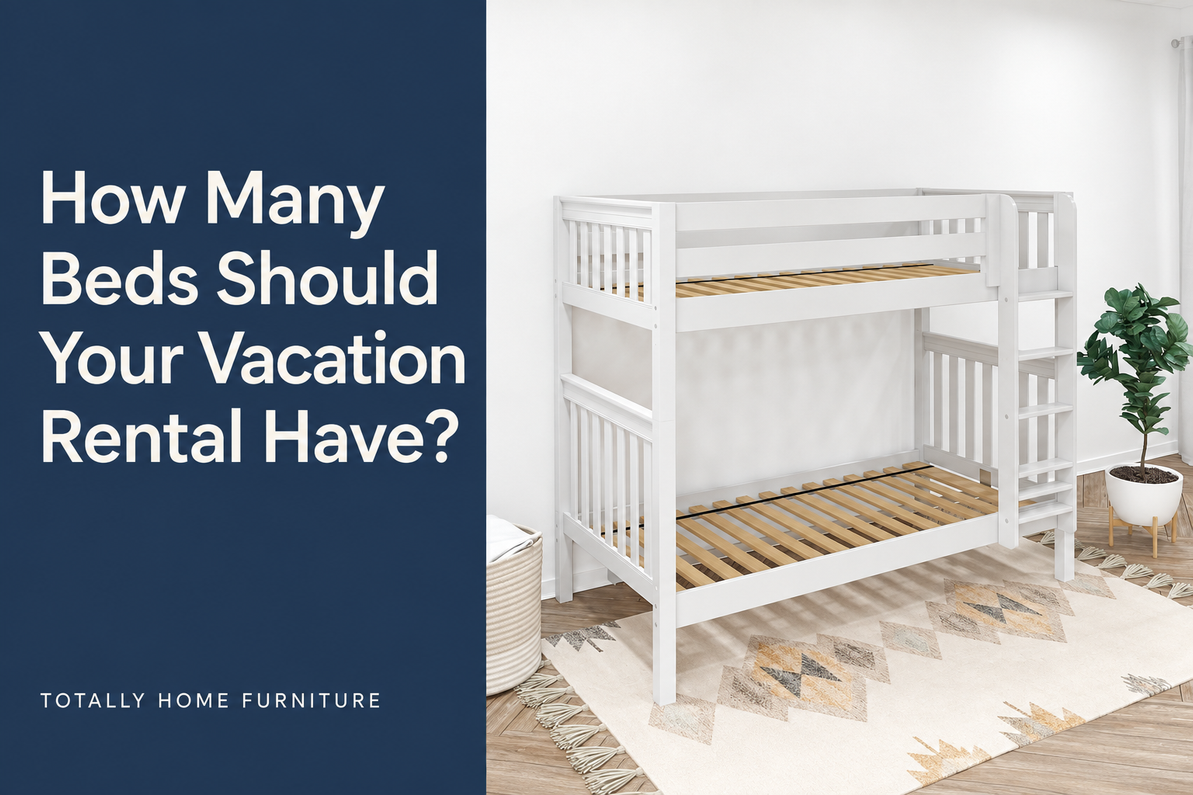
Your vacation rental needs enough suitable sleeping places for the guests you intend to host, within the property's permitted occupancy. Start with that guest limit, decide who will share a mattress and who needs a separate bed, then test the complete layout. There is no reliable rule that every bedroom should sleep two people or that every extra mattress justifies another guest.
For example, two queen beds and two twin beds provide four sleeping surfaces. They could suit two couples and two guests sleeping separately, assuming the beds and property allow that use. They would not give six friends a separate bed each. The same furniture can serve different groups very differently.
Start with the property's guest limit
Confirm the overnight occupancy allowed for your specific property before buying furniture. Check applicable local short-term-rental, building and fire requirements, along with relevant permit conditions, association or lease restrictions and insurance requirements. A booking platform's bed count is not permission to increase that limit. Airbnb's responsible-hosting guidance directs hosts to establish safe occupancy limits and check local requirements.
Then decide whether you want to host fewer people than the permitted maximum. Bathroom access, dining seats, lounge seating, luggage storage and the way guests move through the home affect the experience. A property can have enough mattresses while still feeling inconvenient at breakfast or bedtime.
Count sleeping arrangements, then assign the guests
Make a room-by-room inventory with four details: mattress size, number of sleeping surfaces, intended users and any setup required. Count a bunk's upper and lower levels separately. Include a trundle only if it is actually supplied as a usable bed with the correct mattress. Storage drawers are not extra beds.
Do not use mattress width or a high weight rating as permission to put two guests on an upper bunk. Required U.S. bunk-bed instructions prohibit more than one person on the upper bunk and prohibit children under six from using it. Follow the exact model's instructions, capacities and mattress limits for every sleeping surface.
Assign guests to the inventory as if a booking had arrived. Who is comfortable sharing? Who needs a separate mattress? Can the intended upper-bunk guest use the access safely? Does someone need a bed that can be reached without climbing? These answers are more useful than choosing the largest bed configuration that fits between two walls.
A six-guest example: four beds, three bedrooms
Assume a hypothetical property is permitted and equipped to host six overnight guests. The following plan is for two couples and two people who want individual beds. It is an illustration, not an occupancy recommendation for every three-bedroom rental.
| Space | Sleeping arrangement | Guests assigned | Assumption to check |
|---|---|---|---|
| Bedroom 1 | One conventional queen bed | Two | The pair will share and the bed permits their intended use. |
| Bedroom 2 | One conventional queen bed | Two | The pair will share and the bed permits their intended use. |
| Bedroom 3 | Two separate twin beds | Two | Each guest has a suitable individual mattress and clear access. |
| Living room | No advertised sleeping arrangement | Zero | Shared seating remains available at night. |
This gives the group four mattresses and six sleeping places under the stated assumptions. If the target guests are six adults who each want an individual bed, redesign the bed mix or describe the limitation clearly. Do not assume a queen automatically satisfies two separate-bed requests.
Replacing the two twins with a compatible twin bunk may free some floor area, but still provides two sleeping surfaces. It also introduces upper-bunk age, access and headroom constraints. Adding a trundle would offer a different arrangement for the same permitted group; it would not turn this six-guest property into a seven-guest rental.
Choose the bed mix around the group you want to host
Conventional queen or king beds may suit guests who plan to share. Twin and Twin XL beds offer individual sleeping surfaces. Bunks can help fit separate sleeping levels into a room, while a daybed, trundle or sleeper sofa may make a room flexible. Each choice trades something: floor space, privacy, access, storage or nightly setup.
Customer reviews offer examples of this storage-versus-sleeping-space choice. In a Shopper Approved review of our Brockton XL Bunk Beds, a buyer furnishing a rental described choosing storage drawers for one bunk and a trundle for another. That is a useful choice to make room by room: will the space under the bed serve guests better as storage or as another sleeping surface? Read the Brockton customer review.
A customer preparing for the summer rental season described choosing our Lily White XL Bunk Beds in a Full XL-over-Full XL configuration with a trundle. This illustrates a configuration worth comparing when planning separate sleeping surfaces. Before choosing it for your rental, check who will use each level and whether the room has space for the trundle when open. Read the Lily customer review on Shopper Approved.
For comparison, the current Lily range offers Twin XL, Twin XL over Full XL and Full XL configurations, plus an optional Twin XL storage trundle. The catalog lists the Twin XL frame at 46½ inches wide and the Full XL frame at 61½ inches wide. Both are listed at 84 inches long and 71 inches high. That wider mattress choice uses 15 more inches of frame width; it does not change the one-person upper-bunk rule. Confirm ladder projection and operating clearances separately.
If a bunk layout is appropriate, compare adult bunk beds by the intended users and exact model requirements. Our bunk-bed configuration and occupancy guide explains the differences between sleeping surfaces and permitted use in more detail.
Test the room with every bed ready for sleep
Mark the full assembled furniture footprint on the floor, including ladders or stairs. Open the trundle or sleeper mechanism and place luggage where guests will actually keep it. Check the route from each sleeping place to the room exit and bathroom, and verify that doors, closets and required emergency exits remain usable.
For bunks, check ceiling and mattress-to-ceiling clearance for the intended sleeper, along with the manufacturer's requirements. For pull-out beds, measure the open configuration rather than relying on how tidy the room looks during the day. Our guide to how a trundle works with a bunk bed covers rollout space, access and mattress fit.
Run the turnover routine too. Can the cleaner reach each mattress to change sheets and inspect the frame? Where will spare bedding go? Who opens and closes an occasional bed? Extra sleeping space for guests is useful only when the setup can be prepared and maintained reliably.
Make the listing match the sleeping plan
Describe each room's mattress sizes, bunk levels and shared arrangements, and show the sleeping setup in photos. Identify beds in common areas and explain any pull-out setup. Guests should be able to decide who sleeps where before booking.
Platform totals can be easy to misread. Airbnb's sleeping-arrangement instructions count a bunk as two beds, while some arrangements, including a couch or air mattress, do not increase the displayed bed count. That display convention is separate from your overnight guest limit. Keep the room descriptions, photos and maximum-guest setting consistent with the actual property.
Before ordering, check the complete plan
- Confirm the property's permitted overnight occupancy and the guest number you intend to offer.
- Assign that group to specific sleeping surfaces, including sharing and upper-bunk restrictions.
- Test the room with beds open, luggage in place and access routes clear.
- Confirm the selected bed size, bed-end style and underbed option, along with exact model instructions, mattress limits, included components and delivery fit.
- Make the listing and turnover routine reflect the arrangement guests will receive.
Bring that plan to our personal shoppers: include room dimensions, ceiling heights, the intended guest mix and the models you are comparing. We can help check furniture options and fit while you confirm the property's occupancy requirements with the relevant authorities.

Recent Posts
-
A Bunk Bed for One Child: Room for Everyday Life and Future Plans
One child can have plenty of reasons to keep a bunk bed: a favorite sleeping level, a reading spot … -
More Beds, Not More Bedrooms: What an Extra Sleeping Spot Is Worth to a Short-Term Rental
Quick Nav Overview Why Guest Count Sets Your Rate Before Bedroom Count Does What One Extra Sleepin … -
Bunk and Loft Bed Delivery: What to Expect and How to Prepare
Your guide to receiving and setting up bunk beds, loft beds and other Totally Home furniture—includ …