How More Beds — Not More Bedrooms — Can Drive Better Bookings and Higher Rates on Airbnb, Vrbo, and Booking.com
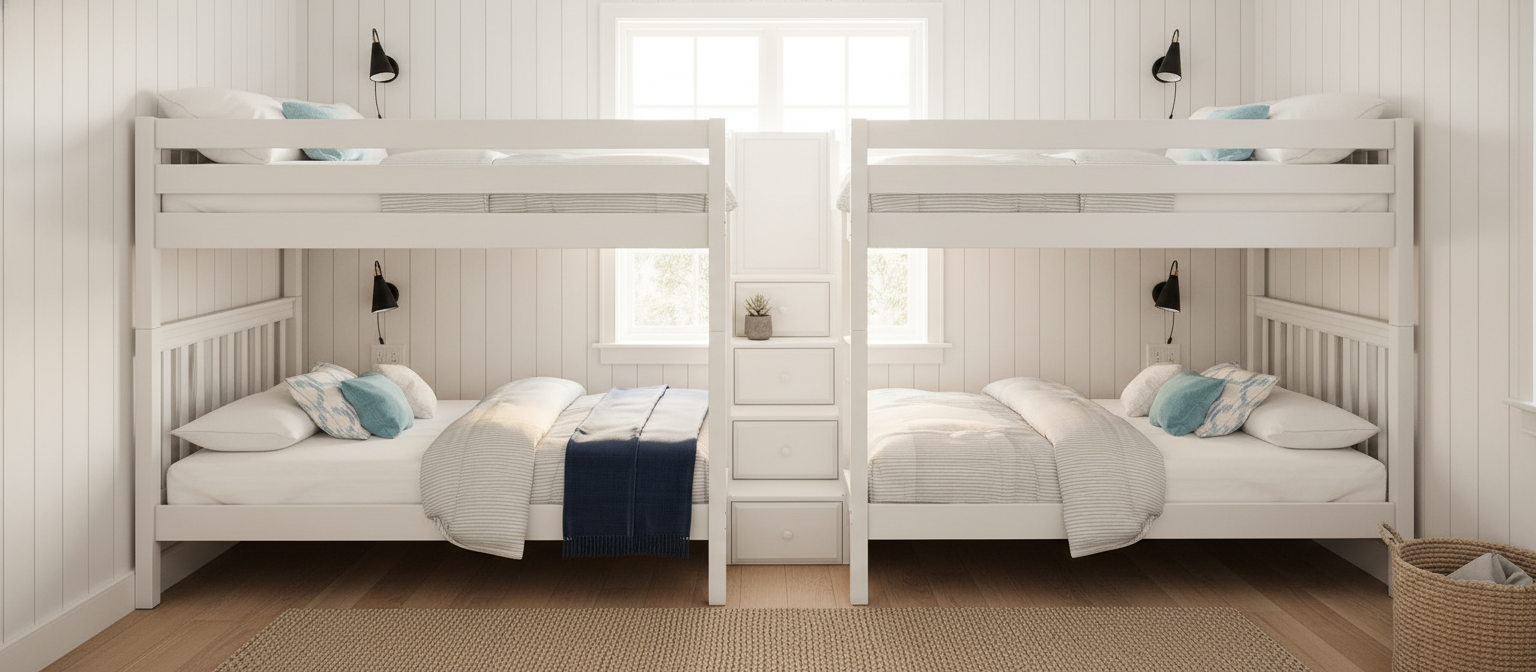
Adding sleeping capacity — without adding bedrooms — is one of the highest-ROI upgrades available to short-term rental hosts. Peer-reviewed research shows a moderate positive correlation between bed count and nightly price. Both Airbnb and Vrbo let hosts set extra guest fees that convert each additional sleeping surface into incremental revenue per booking. Adult-rated bunk beds are the most cost-effective way to add capacity in an existing room.
Every rental host eventually hits the same ceiling: the property is performing okay, but occupancy could be stronger, the nightly rate feels harder to justify, and larger group bookings keep going elsewhere. The instinct is often to think about expanding — another bedroom, a bigger property, a renovation. But the data points to a more accessible lever: sleeping capacity.
Peer-reviewed research shows a measurable positive correlation between the number of beds in a short-term rental and its nightly price.1 The major platforms give hosts direct tools to monetize that capacity through extra guest fees.2, 13 And in a market where U.S. short-term rental occupancy has plateaued around 57%,8 the hosts gaining ground are the ones groups actively choose — not just stumble across.
This guide covers the platform landscape, what research says about capacity and revenue, how guests discover listings across different platforms, and — most practically — how to add meaningful sleeping capacity to almost any property without a renovation.
The Short-Term Rental Platform Landscape in 2026
Short-term rental hosts have more platform options than ever — and which platform matters most depends heavily on your property type, location, and target guest. Before diving into capacity strategy, it's worth understanding where the market actually lives.
| Platform | Global STR Revenue Share (2024) | North America Listing Share | Best For | Extra Guest Fee? |
|---|---|---|---|---|
| Airbnb | 44% (up from 28% in 2019) | ~46% of listings | Urban stays, solo & couples travel, flexible short trips; increasingly competitive in group/family | ✓ Yes — set per-guest threshold & nightly fee in host dashboard |
| Vrbo / Expedia | 9% global; ~29–32% North America | ~32% of N. American listings | Whole-home rentals, family trips, longer stays, beach & mountain destinations — the core family group rental platform | ✓ Yes — set under Standard Fees in Vrbo host dashboard |
| Booking.com | 18% (up from 14% in 2019, fastest-growing) | Smaller U.S. share; dominant in Europe (37%) | Urban, international, and business travel; mixed hotel/rental inventory; rapidly expanding in U.S. | ✓ Yes — hosts set guest capacity and pricing rules per property |
| Direct booking / other | ~29% (declining) | Varies | Repeat guests, direct relationships; avoids platform fees but requires own marketing | You set all pricing rules |
Sources: Skift Research (March 2025);11 MyLighthouse STR Report (March 2025);12 Vrbo Help Center;13 Vrbo via Baselane (2025).14
Which platforms should you list on?
For most U.S. whole-home rental hosts — especially those with 3+ bedrooms targeting families and groups — a dual-listing strategy on Airbnb and Vrbo captures the largest share of relevant demand. Booking.com is worth adding if you host in an urban market or have international guests in mind; its U.S. presence is growing fast and its fee structure (no guest-paid booking fee) can be attractive to certain traveler segments. All three platforms support extra guest fees and guest-count-based search filtering, which means the capacity strategy outlined in this guide applies across all of them.
Does Sleeping Capacity Actually Affect Earnings?
Yes — the data supports a real relationship between capacity and price. A peer-reviewed study published in Frontiers in Psychology analyzed short-term rental listings and found a moderate positive correlation (r = 0.360) between nightly price and guest capacity, alongside similar correlations for number of beds and bedrooms.1 That's not a guarantee — location, reviews, amenities, and seasonality all matter — but it does establish capacity as a legitimate pricing variable, not just a listing detail.
The mechanism works in at least two directions. First, larger groups tend to be willing to pay more in absolute terms because they're splitting the cost across more people — a $800/night house that sleeps 16 works out to $50/person, competitive with a budget hotel. Second, every major platform allows hosts to set an extra guest fee: once your listing exceeds a base number of guests, each additional guest adds a per-night charge to the booking total. More sleeping surfaces, more potential guests, more potential revenue per stay.
Sleeping Capacity Affects More Than Your Rate — It Affects Whether Guests Can Even Find You
On every major short-term rental platform, guest count and bed count are primary search filters — not keywords. This is where many hosts leave performance on the table.
Airbnb confirmed in its 2024 Winter Release that the majority of searches use at least one filter, and that guests routinely filter by rooms and beds when narrowing results.3 Airbnb's Help Center also notes that keyword search within the platform isn't available4 — meaning the guest count, bed count, and bedroom count fields you enter in your listing are your primary on-platform visibility tools.
Vrbo operates similarly. Travelers searching for a "beach house that sleeps 10" or a "mountain cabin for 12" use the guest count filter, not text search. If your listing isn't set to your actual sleeping capacity, you simply don't appear. Vrbo is especially important to get right here because its audience skews toward exactly the group and family travelers most likely to need higher sleeping capacity — and they filter by guest count as a first step, not an afterthought.
On Booking.com, travelers searching for vacation rentals (as opposed to hotels) also use property capacity as a primary filter. With Booking.com rapidly expanding its U.S. vacation rental inventory and now accounting for 18% of global STR revenue,11 it's an increasingly meaningful channel — particularly for urban properties and international travelers who default to Booking.com for everything.
Why the Financial Case for Capacity Is Stronger in 2026
The macro context isn't just interesting background — it's a useful framework for understanding why investing in sleeping capacity now has better odds of paying off than five years ago.
A larger renter pool means a larger addressable market
Harvard's Joint Center for Housing Studies reported that renter households grew by 848,000 in 2024 alone, with the homeownership rate declining.5 For furnished rental and mid-term operators, that's a structurally larger market of people comfortable paying for furnished, flexible living arrangements.
Family and multigenerational travel is a growth segment, not a niche
NYU's 2025 Family Travel Survey found that 92% of parents say they're likely to travel with their children in the coming year.6 Multigenerational trips — grandparents, parents, and kids traveling together — are among the fastest-growing travel categories, and they're the exact group Vrbo was built for. These groups book longer stays, need more sleeping surfaces, and aren't easily accommodated by hotel rooms. Properties that can absorb the whole family in one booking — rather than requiring two hotel rooms — win these bookings consistently.
Long-term stays are growing and they reward good furniture
Airbnb's CEO confirmed in late 2024 that stays of 28 days or longer now represent approximately 17–18% of bookings, up from 13–14% pre-pandemic.7 Long-term stays reduce turnover costs and smooth out revenue — but they require proper adult sleeping setups. Guests staying a month need to actually sleep well, not tolerate a bed.
Flat occupancy means differentiation drives performance
AirDNA data shows U.S. STR occupancy at approximately 56.9% — essentially flat year-over-year.8 In a flat market, revenue growth comes from ADR, not occupancy. And ADR grows when your property justifies a higher rate — which capacity, combined with quality and amenities, helps do.
The Highest-ROI Furniture Upgrade in Short-Term Rentals
Building an addition costs six figures. Turning an existing bedroom into a well-configured adult bunk room costs a fraction of that. Here's how to do it in a way that guests on any platform actually appreciate.
Choose the right bed sizes for adult guests
Standard twin bunk beds work for kids but leave adult guests cramped. For vacation rentals hosting teenagers through grandparents, look at Twin XL, Full, Full XL, or Queen configurations. Totally Home's XL & Queen Bunk Beds lineup includes Twin XL over Full XL, Full over Queen, and Queen-over-Queen options — adult-length sleeping surfaces that guests won't outgrow.
Heavy-duty construction is non-negotiable
Vacation rental furniture takes commercial-level abuse. Standard residential bunk beds will fail under real rental conditions. High Capacity Heavy Duty Bunk Beds are engineered for exactly this use case — select models support up to 2,000 lbs per sleeping surface. The Stalwart Collection is the flagship heavy-duty line, built with the frame integrity and hardware quality that commercial and semi-commercial rental properties demand.
Stairs are worth the floor space
Ladder-access bunks save a few square inches but create real issues in rental properties: they're harder to climb for guests of varying ages and can feel institutional. Bunk beds with stairs create a safer, more guest-friendly experience — and stair-style bunks with built-in drawers double as storage, always at a premium in vacation rentals.
Add per-bunk amenities to elevate the experience
The difference between "dorm room" and "well-designed bunk suite" comes down to a few touches: a reading light at each bunk level, a USB outlet within reach, a small shelf or hook for phone and glasses, and enough headroom to sit up comfortably. These details show up in reviews and distinguish your listing from budget competitors on every platform.
For dual-use rooms, a Murphy bed is worth considering
Not every room can support a permanent bunk setup. A bonus room that doubles as a home office for mid-term guests, or a studio unit where daytime floor space matters, is where a Murphy bed earns its keep. It folds away completely when not in use and photographs well in both configurations — useful for listings that need to show a functional living space alongside the sleeping capacity.
Run the math on your specific property
A 4-bedroom home with queen beds in each room sleeps 8. Replace one bedroom with two sets of Queen Bunk Beds and that same property now sleeps 12 — a 50% increase in capacity with no structural work. Add a Triple Bunk Bed or Quadruple Bunk setup and you're approaching 16 sleeping surfaces. Each additional guest you can accommodate is both a larger pool of bookable groups and, on any platform, potential extra-guest-fee revenue on every stay.
| Use Case | Recommended Configuration | Why It Works |
|---|---|---|
| Bunk room for adults & teens | Twin XL or Full XL Bunk Beds | Adult-length sleeping surface; guests won't hang off the end |
| Couples sharing a bunk room | Queen Bunk Beds | Full adult width for two people per bunk |
| Mixed adult/child family groups | Full Over Queen or Twin Over Queen | Child on top, adult or couple on bottom |
| Maximum capacity in one room | Quad/Triple Bunk Beds | 4–6 sleepers per unit |
| Mid-term rental / furnished apartment | Adult Loft Beds | Frees floor space; works in studios and efficiency units |
| All-ages accessibility | Bunk Beds with Stairs | No ladder; easier upper bunk access; storage stairs available |
| Dual-use room (office by day / guest room by night) | Murphy Bed | Folds away completely; room serves two functions |
Not sure which configuration fits your property?
Safety and Liability: What Every Rental Operator Needs to Know
Before installing any bunk beds in a rental property, work through this checklist. This protects you, your guests, and your reviews across every platform you use.
- ✓Local occupancy rules: Most municipalities limit guests based on square footage, bathrooms, and fire egress. Know your limit before marketing a higher guest count. Adding beds beyond your legal occupancy limit doesn't increase revenue — it creates liability.
- ✓Fire safety and egress: Every sleeping area needs a clear, accessible exit path. Upper bunk occupants need a route to the floor and to the door. Make sure your setup doesn't block windows or interfere with smoke detectors.
- ✓Guardrails and fall protection: Upper bunks require guardrails on all open sides, extending at least 5 inches above the mattress surface per CPSC regulations (16 CFR Parts 1213 and 1513). For adult use, verify guardrail attachment strength under commercial-rate conditions.
- ✓Ceiling clearance: Upper bunks need at least 30–36 inches between mattress surface and ceiling for a seated adult to sit and exit safely. Standard 8-foot ceilings typically accommodate most designs — always measure before ordering.
- ✓Mattress thickness: Most manufacturers recommend 8–12 inch thick mattresses to maintain proper guardrail clearance. Follow per-model specs; thicker mattresses reduce guardrail effectiveness.
- ✓Assembly and maintenance: Assemble to spec, use all provided hardware, and inspect fasteners and guardrails regularly. A loose bolt isn't a minor inconvenience — it's a potential injury and a liability.
For a complete guide, read Safety Considerations for Bunk Beds: A Complete Guide. For a broader look at the tradeoffs, see Pros and Cons of Bunk Beds for Adults.
Destination & Style Playbook: Where Bunk Rooms Win
| Market | Typical Guest Mix | Primary Platform(s) | Configuration to Consider |
|---|---|---|---|
| Nashville, TN | Bachelorette/bachelor, friend trips, events | Airbnb Vrbo | Queen bunks + queen rooms; modern/moody aesthetic |
| Orlando / Kissimmee, FL | Families, theme park trips, multigenerational | Vrbo Airbnb | Twin XL or Full bunks in dedicated bunk room + queen primaries |
| New York, NY | Urban groups, city trips, friend weekends | Airbnb Booking.com | Twin XL or Full XL bunks; Murphy beds in studio-adjacent rooms |
| Las Vegas, NV | Friend groups, event trips, celebrations | Airbnb Vrbo | Queen bunks or Full-over-Queen adjacent to a game room |
| 30A / Seagrove Beach, FL | Multigenerational beach weeks, extended families | Vrbo | Queen-over-Queen bunk rooms + ensuite primaries; coastal aesthetic |
| Gatlinburg, TN | Family reunions, cabin trips | Vrbo Airbnb | Multi-bunk rooms; Twin XL or Queen bunks; rustic/cabin finish |
| Scottsdale, AZ | Families + friend groups, resort-style | Vrbo Airbnb | Queen bunks + ensuite master suites; desert modern aesthetic |
| Port Aransas, TX | Beach groups, coastal families | Vrbo Airbnb | Bunks + trundles; Full XL for adult-length sleeping; coastal casual finish |
Quick Action Plan: Turning a Capacity Upgrade Into Better Booking Performance
Step 1 — Audit your current sleeping surfaces
Count real sleeping surfaces, not just bedrooms. A queen bedroom = 2 sleepers. A room with two queens = 4 sleepers. A bunk room with two Full-over-Full sets = 4–8 sleepers. Know your actual sleeping count — before and after — as the foundation of every other decision.
Step 2 — Choose a realistic target for your market
For most hosts, adding 4–6 sleeping surfaces — pushing from "sleeps 6–8" to "sleeps 10–14" — is where the booking impact is largest, because it opens the door to group sizes underserved in most markets. The sweet spot is just above what most comparable properties in your area can accommodate.
Step 3 — Select the right configuration for your space
Measure room dimensions, ceiling height, door clearance, and egress before ordering. Browse Adult Bunk Beds and XL & Queen Bunk Beds for dedicated bunk rooms. For space-efficiency in smaller rooms, Adult Loft Beds free up floor space below. For dual-purpose rooms, consider a Murphy bed.
Step 4 — Update your listings on every platform
Set your guest count, bed count, and bedroom count fields accurately on Airbnb, Vrbo, and any other platform you use. Update your title and description to include your new sleeping capacity. Add photos specifically of the bunk room with captions explaining the sleep configuration. Do this on every platform — capacity visibility works the same way across all of them.
Step 5 — Implement extra guest fees on each platform
On Airbnb, configure your extra guest fee threshold in your pricing settings. On Vrbo, set it under Standard Fees in the host dashboard. Review your base price to reflect the new capacity. The goal is to capture both the expanded booking pool and the per-guest revenue that comes with it.
Step 6 — Add high-demand amenities alongside the beds
Sleeping capacity gets guests to your listing; the amenity stack closes the booking. Guests searching for large-group rentals filter for kitchen, A/C, washer/dryer, hot tub (in relevant markets), and outdoor space. Think of the bunk room as one piece of a coordinated upgrade.
Ready to put together a plan for your property?
Frequently Asked Questions
Ready to Turn Sleeping Capacity Into Better Booking Performance?
The beds that belong in a professional vacation rental — on Airbnb, Vrbo, or any platform — are built for adult guests: real mattress sizes, weight-rated frames, and configurations that photograph well and hold up under rental conditions.
Want to go deeper on the ROI math? Read the companion post: How to Increase Your Airbnb Profit with Adult Bunk Beds →
1 Frontiers in Psychology / PMC — STR Pricing Study (November 2022): pmc.ncbi.nlm.nih.gov/articles/PMC9709815/
2 Airbnb Help Center — Extra Guest Fee: airbnb.com/help/article/1507
3 Airbnb Newsroom — 2024 Winter Release: news.airbnb.com
4 Airbnb Help Center — Using Search Filters: airbnb.com/help/article/479
5 Harvard JCHS — State of the Nation's Housing 2025: jchs.harvard.edu
6 NYU SPS — 2025 Family Travel Survey: sps.nyu.edu
7 Reuters — Airbnb Long-Term Stays (September 2024): reuters.com
8 AirDNA via Aspen Chamber Research Update (January 2026): aspenchamber.org
9 Expedia Group Q4 2025 Travel Trends: partner.expediagroup.com
10 Vrbo 2025 Rentals of the Year: expedia.com/newsroom
11 Skift Research — STR Market Share 2024 (March 2025): skift.com
12 MyLighthouse — State of the STR Market 2025 (March 2025): mylighthouse.com
13 Vrbo Help Center — Manage Your Fees: help.vrbo.com
14 Baselane — Vrbo Host Requirements & Rules 2026: baselane.com

Recent Posts
-
Bunk Beds for Airbnb: Maximizing Guest Capacity Without Sacrificing Reviews
Quick Nav Why Bunk Beds Are Becoming Popular in Airbnb Rentals Can You Put Bunk Beds in an Airbnb …Mar 26, 2026 -
Bunk Beds with Desks: Creating a Study Space in a Shared Bedroom
When two kids share a bedroom, floor space is always the first thing to disappear. Add homework, a …Mar 24, 2026 -
Loft Beds for Adults: Why They're Not Just for Kids Anymore
Quick Nav Overview What Is an Adult Loft Bed? Are Loft Beds Comfortable for Adults? Why Adults Ar …Mar 23, 2026